AI Tutor vs Live Trainer: What's More Effective for Corporate Training
An AI tutor scales training to hundreds of employees and works 24/7 in 25+ languages, while a live trainer provides depth, motivation, and soft skills assessment. We break down when to choose what and how to combine both approaches without losing quality.
6 min read
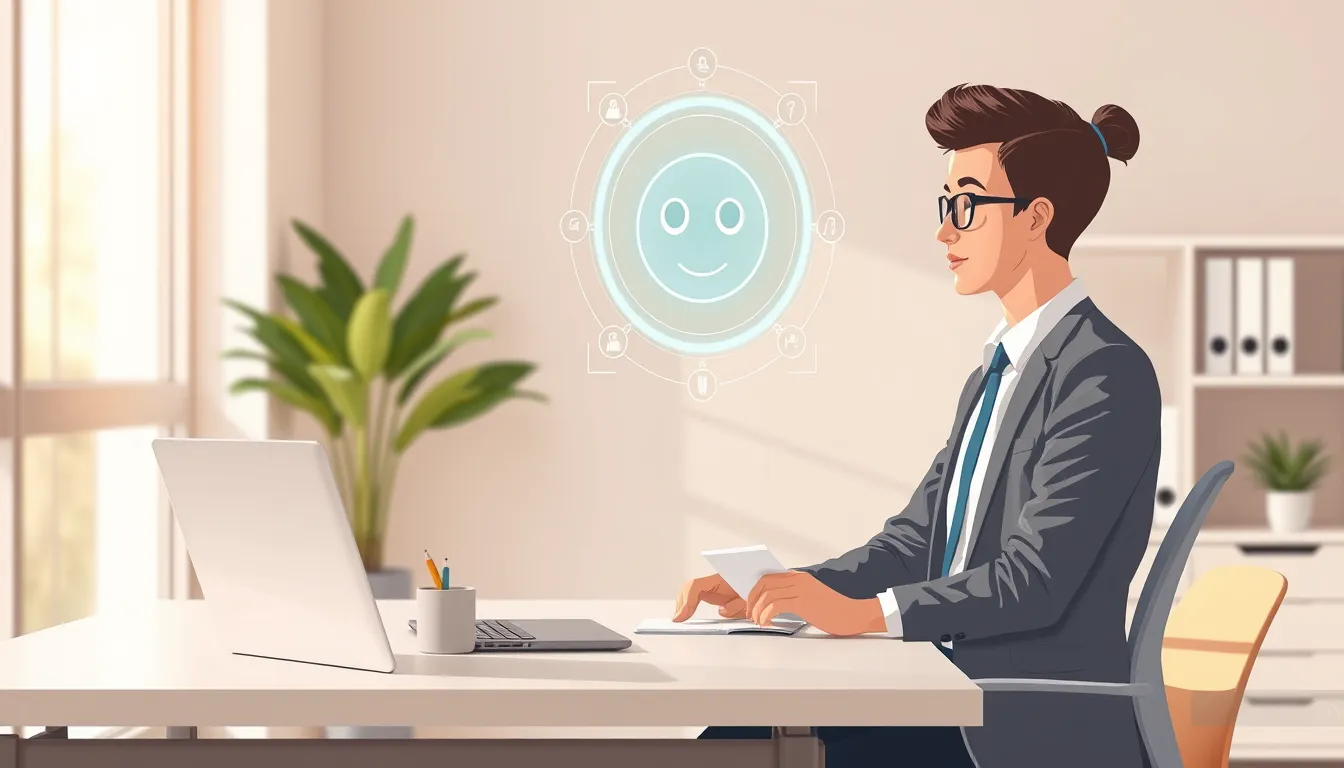
AI tutor vs live trainer — what's more effective for corporate training in 2026? An AI tutor is a generative AI-powered virtual assistant that answers employee questions during the course, explains complex topics simply, and helps reinforce knowledge. It scales training to hundreds of employees simultaneously, while a live trainer provides depth, motivation, and practical skills assessment.
According to Eurostat, in 2025, 19.95% of EU enterprises with 10 or more employees used at least one artificial intelligence technology — 6.47 percentage points more than in 2024. Companies are increasingly adopting AI in internal processes, and corporate training is one of the first areas where the impact is immediately visible.
For HR directors and L&D leaders, this means a paradigm shift: the question is no longer "whether to implement AI in training," but "in which scenarios an AI tutor replaces a trainer, and in which it complements them." Below is a practical comparison with figures, scenarios, and a step-by-step plan.
What is an AI tutor and how does it differ from a live trainer
An AI tutor is a personal assistant based on a large language model, integrated into an LMS and connected to the company's training materials. It answers questions "here and now," adapts explanations to the employee's level, and records knowledge gaps for HR.
A live trainer is a specialist (internal or external) who conducts seminars, workshops, and individual sessions. Their strength lies in personal contact, the ability to read group emotions, and providing feedback on non-verbal cues.
Key difference: an AI tutor works with information and standards, a trainer works with people and their behavior.
AI tutor vs live trainer: what's more effective in 2026
There is no direct "winner" — effectiveness depends on the task. Below is a comparison by key business parameters:
| Parameter | AI tutor | Live trainer |
|---|---|---|
| Total cost of ownership | Fixed platform subscription | Hourly rate or salary of in-house specialist |
| Scale | Unlimited number of employees simultaneously | Usually a group of up to 15–20 people |
| Availability | 24/7, in 25+ languages, from anywhere | Only according to schedule and in one location |
| Feedback speed | Instant, based on course content | Delayed, within the session |
| Motivation | Through gamification, personalized recommendations, and reminders | Through charisma, personal example, and social approval |
| Progress assessment | Automatic analytics for each question | Subjective assessment by the trainer |
Conclusion: for knowledge replication and just-in-time support, an AI tutor wins on economics and reach; for developing leadership qualities and team dynamics, a human is irreplaceable.
When to choose an AI tutor instead of a live trainer
There are five scenarios where an AI tutor delivers maximum impact:
- Onboarding a large flow of new hires. When 20–50 people join the company monthly, a trainer physically cannot answer all questions. An AI tutor handles typical questions like "where to find…", "how to process…" in the first days.
- Recurring training and compliance. Occupational safety, GDPR, security policy — courses that need to be taken annually. An AI tutor helps recall details without organizing an in-person session.
- Distributed teams and different time zones. Employees in branches across Europe receive the same 24/7 support in their native language.
- Knowledge reinforcement after the main course. Microlearning "in the moment": an employee takes a course, and the AI tutor immediately offers a quiz or case on the covered topic.
- Multilingual companies. Automatic dialogue translation allows learning in 25+ languages without localization costs for a trainer.
When you can't do without a live trainer in training
Despite AI capabilities, there are tasks where a human is still irreplaceable:
- Complex soft skills: negotiations, conflict management, public speaking. Here you need role-play with a real opponent and analysis of non-verbal reactions.
- Practical skills: working with equipment, first aid, driving. AI can explain the theory but won't set your hands.
- Motivational and team sessions. Team building, strategy sessions, executive coaching require empathy and trust built through personal contact.
- Assessment and competency evaluation. Final "can/can't" assessment for promotion or dismissal usually requires human participation for legal and ethical integrity.
The optimal model is when an AI tutor handles 70% of routine questions, and the trainer focuses on 30% of high-value activities.
How to implement an AI tutor in a company: step-by-step plan
- Define use cases. Make a list of topics where employees most often ask questions (usually onboarding, compliance, and regulations). Start with one pilot course.
- Upload training materials. PDFs, presentations, company policies — the AI will index them and answer strictly within the uploaded documents, without "hallucinations."
- Configure personalization. Specify roles (salesperson, warehouse worker, manager) — the AI will adapt examples and difficulty to the employee's position.
- Connect analytics. Set up reports: which topics generate the most questions, where employees "get stuck." This is a signal to improve the course or organize a live session.
- Collect feedback after a month. Survey employees: did the AI tutor help, what was missing. Based on results, expand or adjust the knowledge base.
What mistakes are made when comparing AI and trainers
- Mistake 1: Complete replacement of trainers with AI. This leads to loss of motivation and the "human touch" of training. Find out why AI in training sometimes doesn't work and how to fix it — most often due to lack of human oversight.
- Mistake 2: Implementation without clear KPIs. Without measuring "before/after" on question response time or course completion rates, it's impossible to prove ROI.
- Mistake 3: Ignoring AI Act requirements. According to Article 4 of the AI Act (Regulation (EU) 2024/1689) as amended by Regulation (EU) 2026/1744, providers and deployers of AI systems must take measures to support the development of AI literacy among their staff. An AI tutor should not only teach but also help employees work safely with AI.
- Mistake 4: Lack of "human escalation". If an employee doesn't understand the AI's answer, there should be an option to connect a live specialist or HR with one click.
FAQ
Can an AI tutor completely replace a live trainer?
No, for most companies a hybrid model is optimal. An AI tutor covers 70–80% of questions on theory and standards, while a live trainer works on practice, motivation, and complex cases.
Is it safe to use an AI tutor with internal company documents?
Yes, if the platform is GDPR compliant and hosted in the EU. Kelbado does not use corporate data to train external models and ensures client data isolation.
How is an AI tutor related to AI Act requirements for AI literacy?
According to Article 4 of the AI Act, companies must take measures to support the development of AI literacy among their staff. An AI tutor helps employees work safely and effectively with AI tools, increasing their literacy in practice.
In which languages is the AI tutor available?
In Kelbado, the AI tutor supports more than 25 languages, including all official EU languages, and automatically translates dialogues if an employee changes the interface language.
How long does it take to implement an AI tutor?
Basic setup takes from several hours to one day: just upload training materials, and the system will create a personal assistant for each course.
Conclusions
- An AI tutor and a live trainer solve different tasks: the former provides scaling and 24/7 knowledge availability, the latter provides depth, motivation, and behavioral assessment.
- In 2026, the optimal strategy is hybrid: AI handles routine and onboarding, the trainer focuses on developing soft skills and teamwork.
- Start with a pilot on one course with a high frequency of questions, measure response time and employee satisfaction.
- Consider AI Act requirements: an AI tutor should contribute to developing staff AI literacy, not just "answer questions."
Want to test the AI tutor on your documents? Check Kelbado pricing — you can create your first course with an AI assistant for free during the trial period.